Your Health, We Care
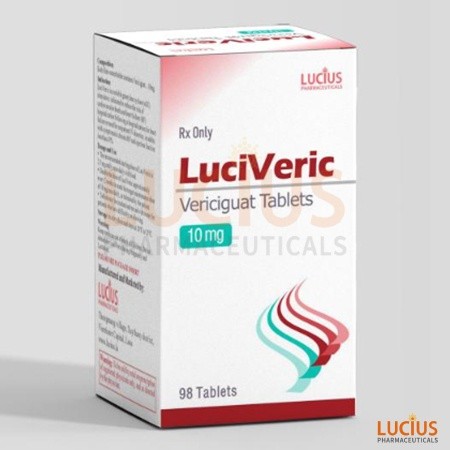
Another NameVerquvo、维立西呱
Indications
Indicated to reduce the risk of cardiovascular death and heart failure hospitalization in adult patients with symptomatic chronic heart failure and ejection fraction less than 45% after hospitalizatio
Specs

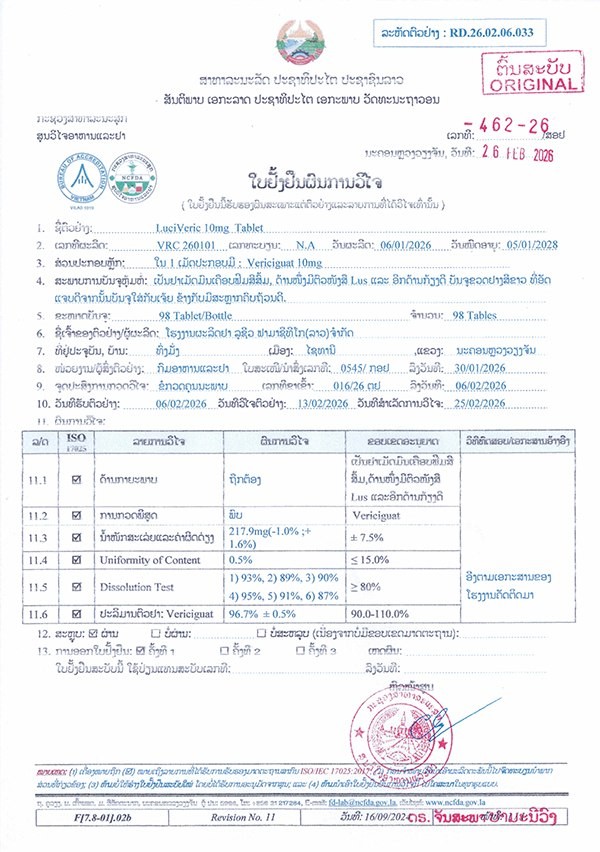
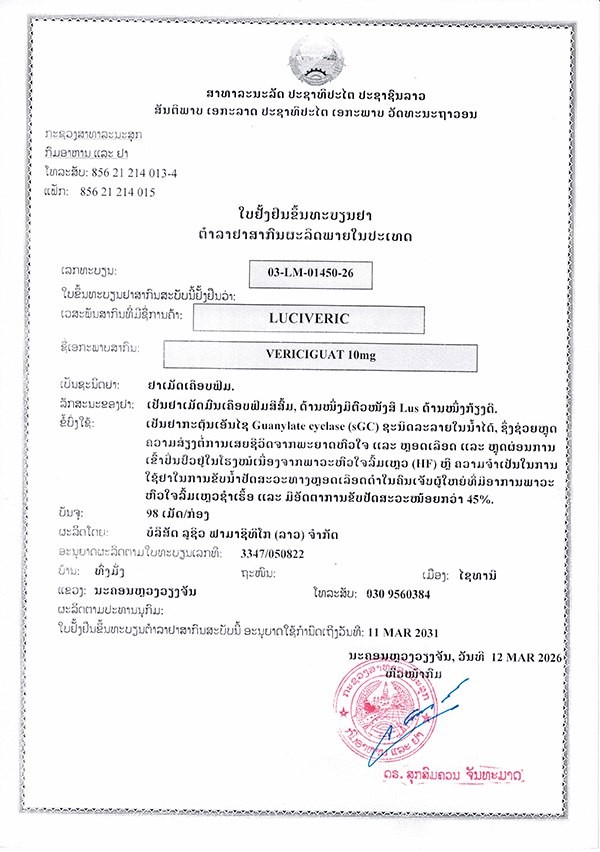
Factory:Lucius Pharmaceuticals
Reg No.:03-LM-01450-26
Inspection No.:462-26
Dosage form:Tablet
Indate:24 months
Vericiguat (LuciVeric) is a soluble guanylate cyclase (sGC) stimulator supplied as oral film-coated tablets, indicated for adult patients with symptomatic chronic heart failure and left ventricular ejection fraction less than 45% to reduce the risk of cardiovascular death and heart failure hospitalization after hospitalization for heart failure or need for outpatient intravenous diuretic therapy.
Vericiguat (LuciVeric) should be added to standard heart failure therapy and may be used in combination with other heart failure medications.
Vericiguat (LuciVeric) must not be used in pregnant women because it may cause fetal harm. Females of reproductive potential: exclude pregnancy before initiating treatment; to prevent pregnancy, females of reproductive potential must use effective contraception during treatment and for one month after discontinuation.
In females of reproductive potential, pregnancy testing should be performed before initiating Vericiguat (LuciVeric) treatment to exclude pregnancy.
Monitor blood pressure before and during treatment, especially in patients at risk of symptomatic hypotension; monitor hemoglobin during treatment to identify anemia.
Vericiguat (LuciVeric) is administered orally with food. For patients unable to swallow tablets whole, the tablet may be crushed and mixed with water immediately before administration.
The recommended starting dose is 2.5 mg once daily with food. Double the dose approximately every 2 weeks, as tolerated, to gradually reach the target maintenance dose of 10 mg once daily.
If a dose is missed, take it as soon as remembered on the same day. Patients should not take two doses of Vericiguat (LuciVeric) on the same day.
Administration of Vericiguat (LuciVeric) to pregnant women may cause fetal harm; Vericiguat (LuciVeric) is contraindicated during pregnancy. Pregnancy status should be verified in females of reproductive potential before Vericiguat (LuciVeric) treatment.
Because Vericiguat (LuciVeric) may cause serious adverse reactions in breastfed infants, women should not breastfeed during Vericiguat (LuciVeric) treatment.
Administration of Vericiguat (LuciVeric) may cause fetal harm; females of reproductive potential should use effective contraception during treatment and for 1 month after the last dose.
The safety and efficacy of Vericiguat (LuciVeric) in pediatric patients have not been established.
No dose adjustment of Vericiguat (LuciVeric) is required in geriatric patients. No overall differences in the safety or efficacy of Vericiguat (LuciVeric) were observed between patients aged 65 years and older and younger patients, but greater sensitivity of some older individuals cannot be ruled out.
No dose adjustment of Vericiguat (LuciVeric) is recommended for patients with mild or moderate hepatic impairment (e.g., Child-Pugh A or B).
Severe hepatic impairment (e.g., Child-Pugh C) has not been established.
No dose adjustment of Vericiguat (LuciVeric) is recommended for patients not receiving dialysis with eGFR ≥15 mL/min/1.73 m².
In heart failure patients with mild, moderate, and severe renal impairment not requiring dialysis, no dose adjustment of Vericiguat (LuciVeric) is required.
No dose adjustment is required.
No dose adjustment is recommended for patients with mild or moderate hepatic impairment (e.g., Child-Pugh A or B); severe hepatic impairment (e.g., Child-Pugh C) has not been studied.
No dose adjustment is recommended for patients not receiving dialysis with estimated glomerular filtration rate (eGFR) ≥15 mL/min/1.73 m².
Vericiguat (LuciVeric) is contraindicated in patients receiving concomitant other soluble guanylate cyclase (sGC) stimulators. Vericiguat (LuciVeric) is contraindicated in pregnancy.
Most common adverse reactions (≥5%): hypotension and anemia.
Vericiguat (LuciVeric) has embryo-fetal toxicity and carries a boxed warning regarding this risk. Females of reproductive potential are a high-risk population.
Pregnancy testing should be performed and pregnancy excluded in females of reproductive potential before initiating treatment; inform females of reproductive potential of the potential risk of Vericiguat (LuciVeric) to the fetus; females of reproductive potential must use effective contraception during treatment and for at least 1 month after the last dose; Vericiguat (LuciVeric) is contraindicated during pregnancy; if pregnancy occurs or is suspected during treatment, inform healthcare providers, who should report any prenatal exposure to the pregnancy surveillance program.
Vericiguat (LuciVeric) causes vasodilation by stimulating soluble guanylate cyclase, which may lead to decreased blood pressure.
Assess blood pressure before and during treatment; for patients at risk of symptomatic hypotension, use a starting dose of 2.5 mg once daily; concomitant use with PDE-5 inhibitors is not recommended; symptomatic treatment should be given for hypotensive overdose.
Vericiguat (LuciVeric) can cause anemia, the mechanism of which is not clear.
Monitor hemoglobin and manifestations related to anemia during treatment; evaluate and manage anemia as clinically needed when it occurs.
Vericiguat (LuciVeric) is contraindicated in patients receiving concomitant other soluble guanylate cyclase stimulators.
Due to the potential for hypotension, concomitant use of Vericiguat (LuciVeric) with PDE-5 inhibitors is not recommended.
The solubility of Vericiguat (LuciVeric) at neutral pH is lower than at acidic pH.
Vericiguat (LuciVeric) is primarily glucuronidated by UGT1A9 and secondarily by UGT1A1 to form an inactive N-glucuronide metabolite; CYP-mediated metabolism is a minor clearance pathway. In vitro studies show that Vericiguat (LuciVeric) does not inhibit CYP1A2, 2B6, 2C8, 2C9, 2C19, 2D6, or 3A4, and does not induce CYP1A2, 2B6, or 3A4; Vericiguat (LuciVeric) does not inhibit UGT1A1, 1A4, 1A6, 1A9, 2B4, or 2B7.
Vericiguat (LuciVeric) is a substrate of P-glycoprotein (P-gp) and breast cancer resistance protein (BCRP), but not a substrate of organic cation transporter 1 (OCT1) or organic anion transporting polypeptides (OATP1B1 and OATP1B3). Vericiguat (LuciVeric) does not inhibit P-gp, BCRP, BSEP, OATP1B1/1B3, OAT1, OAT3, OCT1, OCT2, MATE1, or MATE2K.
Target and Selectivity: Vericiguat (LuciVeric) is a stimulator of soluble guanylate cyclase (sGC), an important enzyme in the nitric oxide (NO) signaling pathway.
Binding Mode: Vericiguat (LuciVeric) directly stimulates sGC in an NO-independent manner and acts synergistically with NO.
Downstream Pathway: When NO binds to sGC, the enzyme catalyzes the synthesis of intracellular cyclic guanosine monophosphate (cGMP); cGMP, as a second messenger, is involved in the regulation of vascular tone, myocardial contractility, and cardiac remodeling. Heart failure is associated with impaired NO synthesis and reduced sGC activity, which may contribute to myocardial and vascular dysfunction. By directly stimulating sGC, Vericiguat (LuciVeric) increases intracellular cGMP levels.

Lucius Pharmaceuticals (Lao) LTD. (Lucius Pharmaceuticals), with its manufacturing campus in Laos located in the capital city of Vientiane in 2020, officially begins its great journey to make effective and affordable medicines available to people in need around the world...More

Lucius Pharmaceutical Co., Ltd., was established in 2020 in Vientiane, the capital of Laos. It aims to offer safe, effective, and affordable medicines globally. With a factory spanning 25,000 square meters, the company manufactures 200+ generic drugs in diverse therapeutic fields.
Address: No.26 Thongmang village, Xaythany district, Vientiane Capital, Laos
E-mail:laoslucius@gmail.com
Name: Lucius

Telegram name: Vira
No.:0085253923643
Telegram name: Vira
No.:0085253923643