Your Health, We Care
Release date: 2026-10-26 16:12:36 Article From: Lucius Laos Recommended: 9
Daraxolacib (LuciDarax) is a RAS GTPase family inhibitor, an oral tablet, administered once daily at 300 mg per dose, for the treatment of adult patients with metastatic pancreatic adenocarcinoma—including both those who have already received at least one prior line of systemic therapy and those who are not suitable for multidrug regimens.
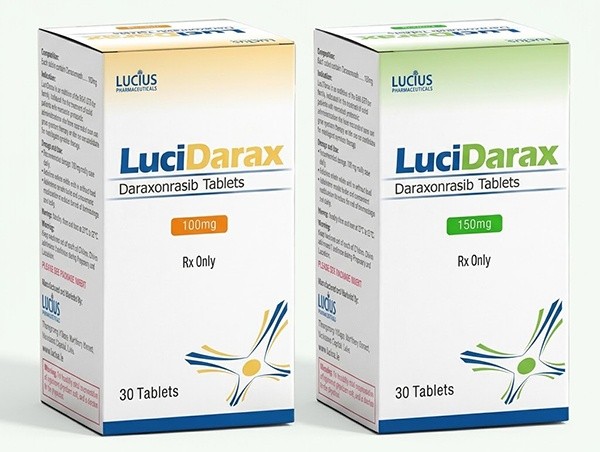
Daraxolacib (LuciDarax)
For the treatment of adult patients with metastatic pancreatic adenocarcinoma who have received at least one prior line of systemic therapy or who are not suitable for multidrug systemic therapy.
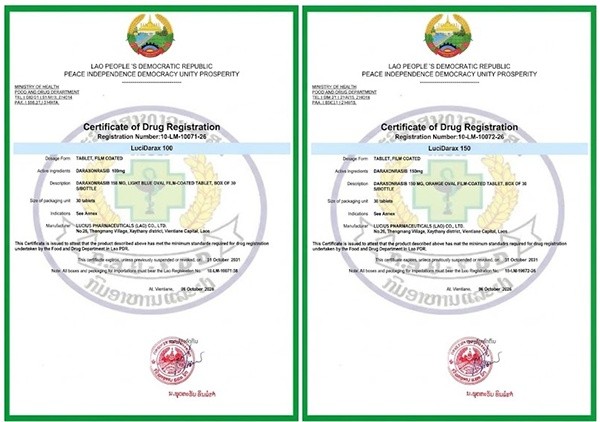
Daraxolacib Drug Approval Certificate
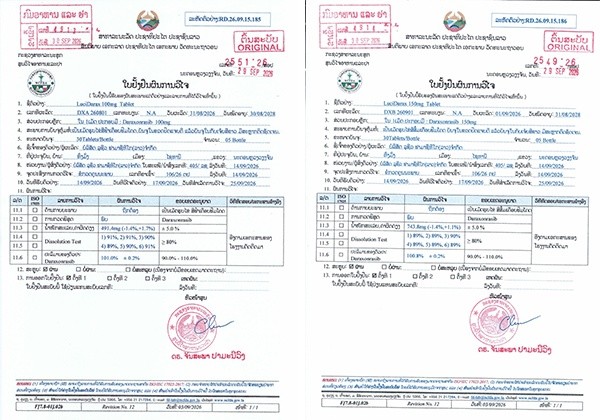
Initiate preventive measures before the first dose to reduce the risk of skin and soft tissue reactions: apply topical corticosteroids to the face and chest and use systemic moisturizers; limit sun exposure and use broad-spectrum sunscreen (SPF 30 or higher); consider prophylactic oral antibiotics, such as doxycycline or minocycline.
The recommended dosage is 300 mg orally once daily, continued until disease progression or unacceptable toxicity. There is no fixed number of courses and no maximum number of cycles.
Take at approximately the same time each day, with or without food.
Swallow whole; do not chew, crush, or split.
If within 4 hours of the scheduled time, take the missed dose; if more than 4 hours, skip it and take the next dose as originally scheduled. Under no circumstances should two doses be taken at once.
Do not replace the dose after vomiting; take the next dose at the originally scheduled time.
1. Pregnancy: There are no available data in pregnant women; animal data suggest fetal harm, and the risk should be communicated.
2. Lactation: There are no data on the presence of Daraxolacib (LuciDarax) and its metabolites in human milk; because of the potential for serious adverse reactions in breastfed infants, do not breastfeed during treatment and for 1 week after the last dose.
3. Females and males of reproductive potential: Verify pregnancy status before initiating treatment; females and male partners of females of reproductive potential should both use effective contraception during treatment and for 1 week after the last dose. The duration is the same for both males and females, 1 week.
4. Pediatric: Safety and efficacy have not been established.
5. Geriatric: No overall differences in safety or efficacy have been observed compared with younger patients.
6. In people with creatinine clearance 30 to 89 mL/min, mild hepatic impairment, or moderate hepatic impairment, there are no clinically significant differences in pharmacokinetics; the effects in people with creatinine clearance below 30 mL/min or severe hepatic impairment (total bilirubin more than 3 to 10 times the upper limit of normal) are unknown.
First reduce to 200 mg daily, then to 150 mg daily for the second reduction; if 150 mg is still not tolerated, permanently discontinue treatment and do not reduce further.
1. Skin and soft tissue toxicity: This is the most common category, such as rash, and also includes pruritus, paronychia, dry skin, and skin fissures. In addition to preventive measures, oral corticosteroids may be added as clinically indicated, and dermatology consultation should be considered.
2. Stomatitis and oral diseases: Use corticosteroid-containing mouthwash; add chlorhexidine mouthwash or 2% lidocaine viscous as needed.
3. Diarrhea: This is the earliest-onset category among all reactions; the median time to improvement from grade 3 is 3 days (1 to 21 days); give antidiarrheal treatment as needed.
4. Gastrointestinal perforation: The median time to first occurrence is 134 days (17 to 254 days)—much later than skin and oral reactions, so do not relax vigilance just because the first few months are uneventful. Suspend treatment for suspected perforation; if no other possible cause is found, reduce the dose or permanently discontinue.
5. Interstitial lung disease/pneumonitis: The median time to first occurrence is 111 days (22 to 242 days). Suspend treatment for new or worsening respiratory symptoms; if no other cause is found, reduce the dose or permanently discontinue.
6. Embryo-fetal toxicity: Females of reproductive potential must use effective contraception during treatment and for 1 week after the last dose; male partners of females of reproductive potential should also use contraception during treatment and for 1 week after the last dose.
Skin and mucosal: rash, stomatitis, paronychia, dry skin, pruritus
Gastrointestinal: diarrhea, nausea, vomiting, abdominal pain, decreased appetite, constipation
Systemic and other: fatigue, edema, hemorrhage, fever, musculoskeletal pain, peripheral neuropathy
Nutritional and electrolyte: decreased albumin, decreased corrected calcium, decreased sodium, decreased magnesium, decreased potassium
Liver function: increased aspartate aminotransferase, increased alanine aminotransferase, increased alkaline phosphatase
Renal function and hematologic: increased creatinine, decreased hemoglobin, decreased lymphocytes, decreased platelets, decreased leukocytes
Perforation: Although uncommon, fatal cases have occurred; seek emergency care immediately for sudden severe abdominal pain
Pneumonitis: Maintain high vigilance; seek immediate medical attention if persistent cough, chest tightness, or unresolved fever occurs
1. Strong CYP3A inhibitors that also inhibit P-gp (e.g., itraconazole): avoid concomitant use.
2. Systemic cyclosporine A and its derivatives: avoid concomitant use.
3. Strong CYP3A inhibitors that do not inhibit P-gp: reduce to 150 mg daily (voriconazole, predicted 2.0-fold increase in exposure).
4. Moderate CYP3A inhibitors that also inhibit P-gp: reduce to 100 mg daily (verapamil, predicted 2.6-fold increase).
5. Moderate CYP3A inhibitors that do not inhibit P-gp: reduce to 200 mg daily (fluconazole, predicted 1.5-fold increase).
6. P-gp inhibitor alone: reduce to 150 mg daily (quinidine, observed 1.8-fold increase).
7. Strong or moderate CYP3A inducers: increase to 400 mg daily (phenytoin reduces exposure to 50%, rifampin to 30%; efavirenz and modafinil reduce exposure to 50% to 84% of the original). In principle, avoid strong inducers; increase the dose only if unavoidable.
8. P-gp substrates: Daraxolacib (LuciDarax) is a P-gp inhibitor, and concomitant use with P-gp substrates (e.g., dabigatran) increases the latter's exposure—dabigatran peak concentration increases 2.5-fold and AUC increases 2.1-fold. Separate administration by at least 4 hours; after dosing with a 4-hour interval, no clinically significant difference is predicted.
9. No adjustment needed: esomeprazole (proton pump inhibitor), midazolam, rosuvastatin, pravastatin; no clinically significant differences were observed with concomitant use.
Note: After discontinuing a strong CYP3A inhibitor, wait 5 days or 3 to 5 half-lives (whichever is longer) before resuming the original dose; after discontinuing a moderate inhibitor or P-gp inhibitor, wait 3 to 5 half-lives; after discontinuing an inducer, wait 7 to 14 days.
20 to 25°C, with excursions permitted between 15 and 30°C. The bottle contains a desiccant packet and is equipped with a child-resistant cap. The bottle contains 30 tablets. The package insert does not specify a use period after opening.
On November 21, 2025, the U.S. Food and Drug Administration (FDA) approved the regimen of pembrolizu···【more】
Recommended:8692025-17-12
Lung cancer is the most rapidly increasing malignant tumor with the fastest increasing morbidity and···【more】
Recommended:10682024-09-07
Recently, Lao Lucius Pharmaceutical (Lucius Pharmaceuticals) issued a solemn statement regarding cou···【more】
Recommended:5782026-10-10
Lucius Pharmaceuticals Version of Vibegron Now Available1.Basic Drug InformationVibegron (generic na···【more】
Recommended:4392026-06-08
In recent years, leveraging the World Trade Organization (WTO) patent waiver for least-developed cou···【more】
Recommended:6422026-05-08
How Can Chinese Patients Access Generic Drugs from Laos?In recent years, generic drugs from Laos hav···【more】
Recommended:6312026-04-08
Lucius Pharmaceuticals version of Ibrutinib is now availableIn a randomized controlled trial of 269 ···【more】
Recommended:4952026-03-08
Leveraging the WTO patent waiver for least-developed countries (extended to 2033), Laos has seen rap···【more】
Recommended:6682026-31-07

Lucius Pharmaceuticals (Lao) LTD. (Lucius Pharmaceuticals), with its manufacturing campus in Laos located in the capital city of Vientiane in 2020, officially begins its great journey to make effective and affordable medicines available to people in need around the world...More

Lucius Pharmaceutical Co., Ltd., was established in 2020 in Vientiane, the capital of Laos. It aims to offer safe, effective, and affordable medicines globally. With a factory spanning 25,000 square meters, the company manufactures 200+ generic drugs in diverse therapeutic fields.
Address: No.26 Thongmang village, Xaythany district, Vientiane Capital, Laos
E-mail:laoslucius@gmail.com

Name: Lucius

Telegram name: Vira
No.:0085253923643
Telegram name: Vira
No.:0085253923643