Your Health, We Care
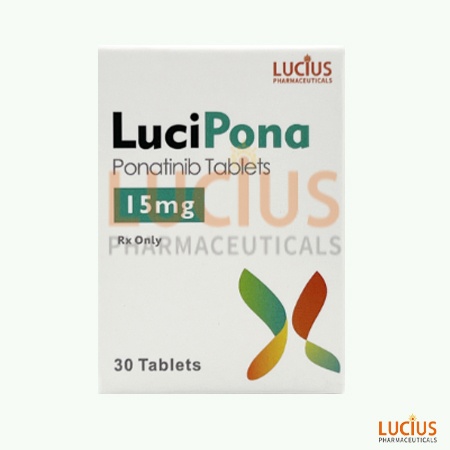
The active ingredient of this product is Ponatinib Hydrochloride, with the dosage calculated based on ponatinib.
Administer orally at an initial dose of 45 mg once daily. When the patient achieves a BCR-ABL1 International Standard (IS) ≤ 1%, the dose may be reduced to 15 mg once daily.
If the patient loses efficacy at a dose of 15 mg once daily, the dose may be escalated back to the previously tolerated level (30 mg or 45 mg once daily).
Continue treatment until the patient loses efficacy again after dose escalation or experiences intolerable toxic reactions.
Discontinuation should be considered if no hematologic response is achieved after 3 months of treatment.
Administer orally at an initial dose of 45 mg once daily; the optimal dose has not been established.
For patients with accelerated-phase CML who achieve a major cytogenetic response, dose reduction may be considered.
Continue treatment until the patient loses efficacy or experiences intolerable toxic reactions.
Discontinuation should be considered if no hematologic response is achieved after 3 months of treatment.
Administer orally at an initial dose of 30 mg once daily in combination with chemotherapy. At the end of induction therapy, if the patient achieves a complete remission status with minimal residual disease (MRD) negativity (BCR::ABL1/ABL1 ≤ 0.01%), the dose may be reduced to 15 mg once daily. Continue combined chemotherapy for up to 20 cycles until the patient loses efficacy or experiences intolerable toxic reactions.
Administer orally at an initial dose of 45 mg once daily as monotherapy; the optimal dose has not been established. Continue treatment until the patient loses efficacy or experiences intolerable toxic reactions. Discontinuation should be considered if no response is achieved after 3 months of treatment.
In case of adverse reactions, treatment interruption, dose reduction, or permanent discontinuation should be implemented based on the specific situation. If dose adjustment is necessary, refer to the following stepwise regimen:
First dose adjustment: 30 mg once daily;
Second dose adjustment: 15 mg once daily;
Third dose adjustment: 10 mg once daily;
Permanent discontinuation is required if the patient remains unable to tolerate a dose of 10 mg once daily thereafter.
First dose adjustment: 30 mg once daily
Second dose adjustment: 15 mg once daily
Permanent discontinuation is required if the patient is unable to tolerate a dose of 15 mg once daily thereafter.
First dose adjustment: 15 mg once daily
Second dose adjustment: 10 mg once daily
Permanent discontinuation is required if the patient remains unable to tolerate a dose of 10 mg once daily thereafter.
Permanent discontinuation is mandatory for patients who cannot tolerate the above minimum recommended doses.
The following dose adjustment measures are recommended based on the type and severity of specific adverse reactions:
Grade 1 event: Interrupt treatment until symptoms resolve, then resume the original dose.
Grade 2 event: Interrupt treatment until symptoms improve to Grade 0–1, then resume at the next lower dose; discontinue treatment if the event recurs.
Grade 3–4 events: Discontinue treatment permanently.
Grade 1 event: Interrupt treatment until symptoms resolve, then resume the original dose.
Grade 2 event: Interrupt treatment until symptoms improve to Grade 0–1, then resume the original dose; if the event recurs, interrupt treatment until symptoms improve to Grade 0–1, then resume at the next lower dose.
Grade 3 event: Interrupt treatment until symptoms improve to Grade 0–1, then resume at the next lower dose; discontinue treatment if the event recurs.
Grade 4 event: Discontinue treatment permanently.
Grade 1 event: Interrupt treatment until symptoms resolve, then resume the original dose.
Grade 2 event: Interrupt treatment until symptoms improve to Grade 0–1, then resume the original dose; if the event recurs, interrupt treatment until symptoms improve to Grade 0–1, then resume at the next lower dose.
Grade 3 event: Interrupt treatment until symptoms improve to Grade 0–1, then resume at the next lower dose; discontinue treatment if the event recurs.
Grade 4 event: Discontinue treatment permanently.
Grade 2–3 events: Interrupt treatment until symptoms improve to Grade 0–1, then resume at the next lower dose; discontinue treatment if the event recurs.
Grade 4 event: Discontinue treatment permanently.
If aspartate aminotransferase (AST) or alanine aminotransferase (ALT) levels exceed 3 times the upper limit of normal (ULN), interrupt treatment until levels return to Grade 0–1, then resume at the next lower dose. Permanent discontinuation is required if AST or ALT ≥ 3×ULN is accompanied by bilirubin > 2×ULN and alkaline phosphatase < 2×ULN.
Serum lipase > 1–1.5×ULN: Consider interrupting treatment until symptoms resolve, then resume the original dose.
Serum lipase > 1.5–2×ULN; or serum lipase 2–5×ULN without symptoms; or asymptomatic pancreatitis confirmed by imaging: Interrupt treatment until symptoms improve to Grade 0–1 (lipase < 1.5×ULN), then resume at the next lower dose.
Serum lipase 2–5×ULN with symptoms; or Grade 3 symptomatic pancreatitis; or serum lipase > 5×ULN without symptoms: Interrupt treatment until symptoms resolve completely and lipase levels return to Grade 0–1, then resume at the next lower dose.
Symptomatic pancreatitis with serum lipase > 5×ULN: Discontinue treatment permanently.
If the absolute neutrophil count (ANC) < 1,000/mm³ or platelet count < 50,000/mm³, interrupt treatment until ANC ≥ 1,500/mm³ and platelet count ≥ 75,000/mm³, then resume the original dose. If myelosuppression recurs, interrupt treatment until parameters recover, then resume at the next lower dose.
Grade 1 event: Interrupt treatment until symptoms resolve, then resume the original dose.
Grade 2 event: Interrupt treatment until symptoms improve to Grade 0–1, then resume the original dose; if the adverse reaction recurs, interrupt treatment until symptoms improve to Grade 0–1, then resume at the next lower dose.
Grade 3–4 events: Interrupt treatment until symptoms improve to Grade 0–1, then resume at the next lower dose; discontinue treatment permanently if the adverse reaction recurs.
Coadministration of ponatinib with potent CYP3A inhibitors should be avoided whenever possible. If coadministration is unavoidable, reduce the dose of ponatinib according to the current dosage:
Current dose: 45 mg once daily → Recommended dose during coadministration: 30 mg once daily
Current dose: 30 mg once daily → Recommended dose during coadministration: 15 mg once daily
Current dose: 15 mg once daily → Recommended dose during coadministration: 10 mg once daily
Current dose: 10 mg once daily → Coadministration with potent CYP3A inhibitors should be avoided
Resume the patient’s tolerated pre-coadministration dose of ponatinib 3–5 elimination half-lives after discontinuation of the potent CYP3A inhibitor.
FDA,2022.02
Ponatinib is a third-generation tyrosine kinase inhibitor (TKI) primarily indicated for the treatmen···【more】
Recommended:892026-20-01
Ponatinib is an oral tyrosine kinase inhibitor primarily indicated for the treatment of specific typ···【more】
Recommended:702026-20-01
Ponatinib is a third-generation tyrosine kinase inhibitor (TKI) primarily indicated for the treatment of specific types of leukemia, such as Philadelphia chromosome-positive chroni···【more】
Article source:Lucius LaosRelease date:2026-01-20Recommended:89
Ponatinib is an oral tyrosine kinase inhibitor primarily indicated for the treatment of specific types of leukemia. It is particularly effective for chronic myeloid leukemia (CML) ···【more】
Article source:Lucius LaosRelease date:2026-01-20Recommended:70

Lucius Pharmaceuticals (Lao) LTD. (Lucius Pharmaceuticals), with its manufacturing campus in Laos located in the capital city of Vientiane in 2020, officially begins its great journey to make effective and affordable medicines available to people in need around the world...More

Lucius Pharmaceutical Co., Ltd., was established in 2020 in Vientiane, the capital of Laos. It aims to offer safe, effective, and affordable medicines globally. With a factory spanning 25,000 square meters, the company manufactures 200+ generic drugs in diverse therapeutic fields.
Address:No.26 Thongmang village, Xaythany district, Vientiane Capital, Laos
E-mail:laoslucius@gmail.com
Whatsapp: