Your Health, We Care
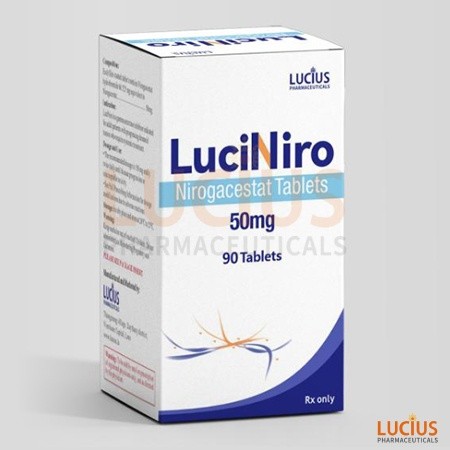
Another NameOgsiveo、奥格西韦奥、尼伽司他
Indications
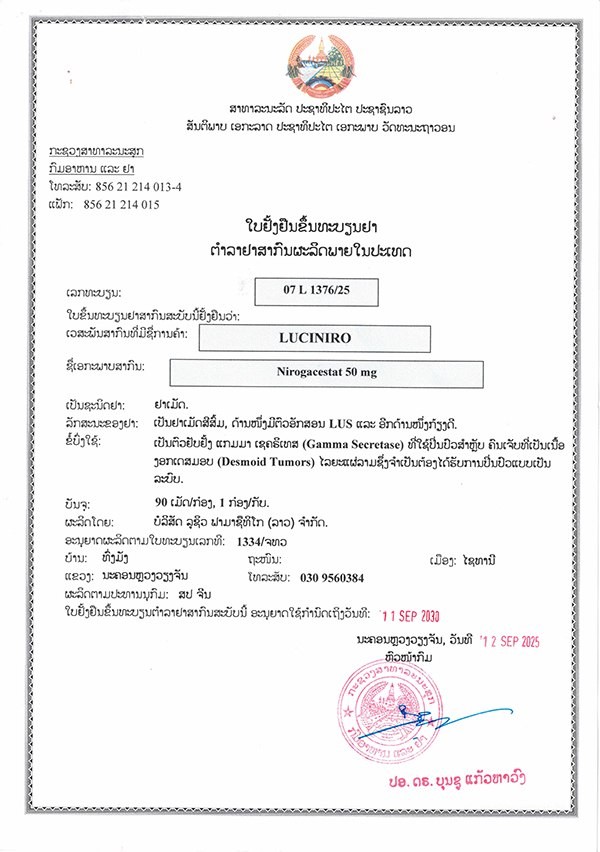
Nirogacestat (LuciNiro) is indicated for adult patients with progressing desmoid tumors who require systemic therapy.
Specs

Factory:Lucius Pharmaceuticals
Reg No.:07 L 1376/25
Inspection No.:1818-25
Dosage form:Tablet
Indate:24 months
Nirogacestat (LuciNiro) is a gamma-secretase inhibitor supplied as oral film-coated tablets. It exerts its antitumor effect by blocking the proteolytic activation of Notch receptors. It is indicated for adult patients with progressing disease who require oral or injectable systemic therapy.

The following screenings should be completed before initiating Nirogacestat (LuciNiro) treatment:
For women of reproductive potential, pregnancy status should be verified and a pregnancy test should be performed before initiating Nirogacestat (LuciNiro) treatment.
Dermatologic examination should be performed before initiating Nirogacestat (LuciNiro) treatment because Nirogacestat (LuciNiro) can cause new non-melanoma skin cancers.
Liver function tests, including aspartate aminotransferase (AST) and alanine aminotransferase (ALT), should be obtained before initiating treatment as a baseline for subsequent periodic monitoring.
Phosphate and potassium should be tested before initiating treatment because Nirogacestat (LuciNiro) can cause electrolyte abnormalities.
All concomitant medications, including prescription drugs, over-the-counter drugs, vitamins, and herbal products, should be reviewed to screen for strong or moderate cytochrome P450 (CYP) 3A inhibitors, strong or moderate CYP3A inducers, proton pump inhibitors, and H2 receptor antagonists.
The following monitoring should be performed during treatment.
Observe the occurrence and duration of diarrhea and manage it with antidiarrheal medications according to severity.
Monitor for changes in menstrual cycle regularity and the occurrence of estrogen deficiency symptoms, including hot flashes, night sweats, and vaginal dryness, to assess ovarian toxicity.
Monitor liver function periodically, including AST and ALT.
Perform dermatologic examinations periodically during treatment to detect new non-melanoma skin cancers.
Monitor phosphate and potassium levels periodically and supplement as needed.
Monitor for signs and symptoms of hypersensitivity reactions during treatment.
Nirogacestat (LuciNiro) is administered orally at 150 mg twice daily, with or without food. Swallow tablets whole; do not crush, split, or chew the tablets before swallowing. Administer at approximately 12-hour intervals according to the "twice daily" schedule.
The recommended dosage of Nirogacestat (LuciNiro) is 150 mg orally twice daily, continued until disease progression or unacceptable toxicity.
If a patient vomits or misses a dose, instruct the patient to take the next dose at the regularly scheduled time. Do not take two doses at once to make up for a missed dose.
Nirogacestat (LuciNiro) can interfere with normal gastrointestinal function, causing diarrhea, sometimes severe. Monitor patients for diarrhea, manage with antidiarrheal medications, and adjust the dose as recommended:
For diarrhea lasting 3 days or more that does not resolve with maximal medical therapy and reaches Grade 3 or 4, withhold Nirogacestat (LuciNiro) until recovery to Grade 1 or lower or baseline, then restart at 100 mg twice daily. Instruct patients to contact their healthcare provider immediately if diarrhea persists for several days and does not resolve with antidiarrheal medications.
Nirogacestat (LuciNiro) may impair female reproductive function and fertility. Inform patients of the potential risk of ovarian toxicity before initiating Nirogacestat (LuciNiro) treatment, and routinely monitor patients for changes in menstrual cycle regularity or the occurrence of estrogen deficiency symptoms, including hot flashes, night sweats, and vaginal dryness.
Nirogacestat (LuciNiro) can cause elevated transaminases. Monitor liver function tests periodically and adjust the dose as recommended:
For ALT or AST elevation reaching Grade 2 (≥3 to 5 times ULN), withhold Nirogacestat (LuciNiro) until ALT, AST, or both recover to<3 times="" uln="" or="" baseline="">5 times ULN), permanently discontinue.
New non-melanoma skin cancers, including cutaneous squamous cell carcinoma and basal cell carcinoma, can occur in patients receiving Nirogacestat (LuciNiro). Patients should contact their healthcare provider if any new or changing skin lesions appear.
Electrolyte abnormalities, primarily decreased phosphate and decreased potassium, can occur in patients receiving Nirogacestat (LuciNiro). Monitor phosphate and potassium levels periodically and supplement as needed, and adjust the dose as recommended:
For hypophosphatemia lasting 3 days or more that does not resolve with maximal phosphate supplementation and reaches Grade 3 or 4, and for hypokalemia that does not resolve with maximal potassium supplementation and reaches Grade 3 or 4, withhold Nirogacestat (LuciNiro) until recovery to Grade 1 or lower or baseline, then restart at 100 mg twice daily. Patients should contact their healthcare provider if muscle pain or muscle weakness occurs.
Hypersensitivity reactions, including severe hypersensitivity reactions, have been reported in postmarketing use of Nirogacestat (LuciNiro). Monitor patients for signs and symptoms of hypersensitivity reactions during treatment and manage as clinically indicated; interrupt or permanently discontinue based on severity: permanently discontinue for anaphylactic shock or other severe hypersensitivity reactions reaching Grade 3 or 4. Patients should immediately report manifestations of hypersensitivity reactions to their healthcare provider.
Nirogacestat (LuciNiro) can cause fetal harm when administered to pregnant women. There are no available data on the use of Nirogacestat (LuciNiro) in pregnant women.
Inform pregnant women of the potential risk to the fetus; inform women and men of reproductive potential to use effective contraception during treatment with Nirogacestat (LuciNiro) and for 1 week after the last dose.
For women of reproductive potential using hormonal contraceptives, barrier contraception is recommended in addition because Nirogacestat (LuciNiro) can affect ovarian function and follicular development, which may reduce the effectiveness of hormonal contraceptives.
Inform pregnant women of the potential risk to the fetus.
There are no data to indicate whether Nirogacestat or its metabolites are present in human milk, and there are no data on the effects of Nirogacestat on the breastfed child or on milk production. Because of the potential for serious adverse reactions in breastfed children, inform women not to breastfeed during treatment with Nirogacestat (LuciNiro) and for 1 week after the last dose.
Nirogacestat (LuciNiro) can cause fetal harm when administered to pregnant women.
For women of reproductive potential, verify pregnancy status before initiating Nirogacestat (LuciNiro) treatment.
Women of reproductive potential should use effective contraception during treatment with Nirogacestat (LuciNiro) and for 1 week after the last dose; because Nirogacestat (LuciNiro) can affect ovarian function and follicular development and may reduce the effectiveness of hormonal contraceptives, women using hormonal contraceptives are advised to add barrier contraception.
Men with female partners of reproductive potential should use effective contraception during treatment with Nirogacestat (LuciNiro) and for 1 week after the last dose.
The safety and efficacy of Nirogacestat (LuciNiro) in pediatric patients have not been established.
Clinical studies of Nirogacestat (LuciNiro) did not include a sufficient number of patients aged 65 years and older to determine whether they respond differently from younger adult patients.
In subjects with moderate hepatic impairment (Child-Pugh B or National Cancer Institute Organ Dysfunction Working Group [NCI-ODWG] Group C), mean AUC increased by up to 16% and mean Cmax decreased by up to 39%.
The effect of severe hepatic impairment on the pharmacokinetics of Nirogacestat (LuciNiro) has not been established.
Based on age (18 to 80 years), sex, race (Asian 2.1%, Black or African American 26%, White 66%), or mild or moderate renal impairment (eGFR ≥41 mL/min/1.73 m²), no clinically meaningful differences in the pharmacokinetics of Nirogacestat (LuciNiro) were observed.
Serious adverse reactions: diarrhea, ovarian toxicity, hepatotoxicity, non-melanoma skin cancer, electrolyte abnormalities, hypersensitivity reactions.
Most common adverse reactions (>15%): diarrhea, ovarian toxicity, rash, nausea, fatigue, stomatitis, headache, abdominal pain, cough, alopecia, upper respiratory tract infection, and dyspnea. These adverse reactions were those with a difference of ≥5% compared with placebo and an incidence of ≥15% in the DeFi study.
Most common laboratory abnormalities (≥15%): decreased phosphate, increased urine glucose, increased urine protein, increased aspartate aminotransferase (AST), increased alanine aminotransferase (ALT), and decreased potassium.
Nirogacestat is a substrate of CYP3A.
Strong or moderate CYP3A inhibitors can increase exposure to Nirogacestat, which may increase the risk of adverse reactions with Nirogacestat (LuciNiro). Avoid concomitant use of Nirogacestat (LuciNiro) with strong or moderate CYP3A inhibitors, including grapefruit products, Seville oranges, and starfruit.
Strong or moderate CYP3A inducers can decrease serum exposure to Nirogacestat, which may reduce the efficacy of Nirogacestat (LuciNiro). Avoid concomitant use of Nirogacestat (LuciNiro) with strong or moderate CYP3A inducers.
Nirogacestat has poor solubility at pH ≥6, and gastric acid-reducing agents can decrease serum exposure to Nirogacestat, which may reduce the efficacy of Nirogacestat (LuciNiro). Avoid concomitant use of Nirogacestat (LuciNiro) with proton pump inhibitors (e.g., omeprazole) and H2 receptor antagonists (e.g., famotidine).
If concomitant use cannot be avoided, Nirogacestat (LuciNiro) can be administered separated from antacids, i.e., administer Nirogacestat (LuciNiro) 2 hours before or 2 hours after antacids (e.g., calcium-containing antacids).
Nirogacestat can increase exposure to CYP3A substrates, which may increase the risk of adverse reactions associated with these substrates. Avoid concomitant use of Nirogacestat (LuciNiro) with CYP3A substrates for which small changes in concentration may lead to serious adverse reactions.
Nirogacestat can decrease exposure to CYP2C19 substrates, which may reduce the efficacy of these substrates. When Nirogacestat (LuciNiro) 150 mg twice daily is coadministered with sensitive CYP2C19 substrates, plasma concentrations of these substrates may be reduced; unless otherwise recommended in the prescribing information for the CYP2C19 substrate, avoid concomitant use of Nirogacestat (LuciNiro) with CYP2C19 substrates.
Nirogacestat is a substrate of P-glycoprotein (P-gp) but not a substrate of breast cancer resistance protein (BCRP), organic anion transporting polypeptide 1B1 (OATP1B1), or organic anion transporting polypeptide 1B3 (OATP1B3); Nirogacestat inhibits P-gp but does not inhibit BCRP, multidrug and toxin extrusion protein 1 (MATE1), multidrug and toxin extrusion protein 2-K (MATE2-K), OATP1B1, OATP1B3, organic anion transporter 1 (OAT1), organic anion transporter 2 (OAT2), or organic anion transporter 3 (OAT3).
Nirogacestat does not inhibit CYP1A2, 2B6, 2C8, 2C9, 2C19, or 2D6; Nirogacestat induces CYP2B6, CYP2C8, CYP2C9, and CYP2C19 but does not induce CYP1A2. No clinically meaningful differences in the pharmacokinetics of dabigatran (a P-gp substrate) were observed with concomitant Nirogacestat; no clinically meaningful differences in the pharmacokinetics of rosiglitazone (a CYP2C8 substrate) or S-warfarin (a CYP2C9 substrate) are expected with concomitant Nirogacestat.
Target and Selectivity: Nirogacestat is a gamma-secretase inhibitor that exerts its effect by blocking the proteolytic activation of Notch receptors.
Downstream Pathway: Notch receptors function after proteolytic activation; when Notch signaling is dysregulated, it can activate pathways that promote tumor growth. By blocking this proteolytic activation process, Nirogacestat inhibits pro-tumor growth signals driven by Notch dysregulation.

Lucius Pharmaceuticals (Lao) LTD. (Lucius Pharmaceuticals), with its manufacturing campus in Laos located in the capital city of Vientiane in 2020, officially begins its great journey to make effective and affordable medicines available to people in need around the world...More

Lucius Pharmaceutical Co., Ltd., was established in 2020 in Vientiane, the capital of Laos. It aims to offer safe, effective, and affordable medicines globally. With a factory spanning 25,000 square meters, the company manufactures 200+ generic drugs in diverse therapeutic fields.
Address: No.26 Thongmang village, Xaythany district, Vientiane Capital, Laos
E-mail:laoslucius@gmail.com
Name: Lucius

Telegram name: Vira
No.:0085253923643
Telegram name: Vira
No.:0085253923643