Your Health, We Care
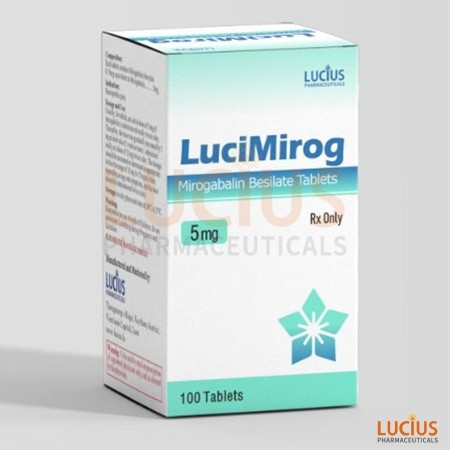
Another NameTarlige、美洛加巴林
Indications
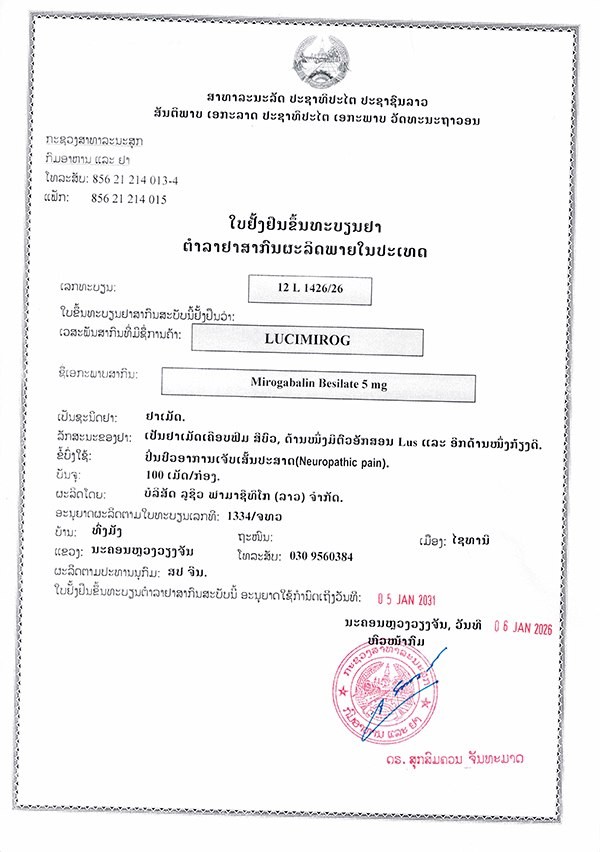
neuropathic pain
Specs

Factory:Lucius Pharmaceuticals
Reg No.:12 L 1426/26
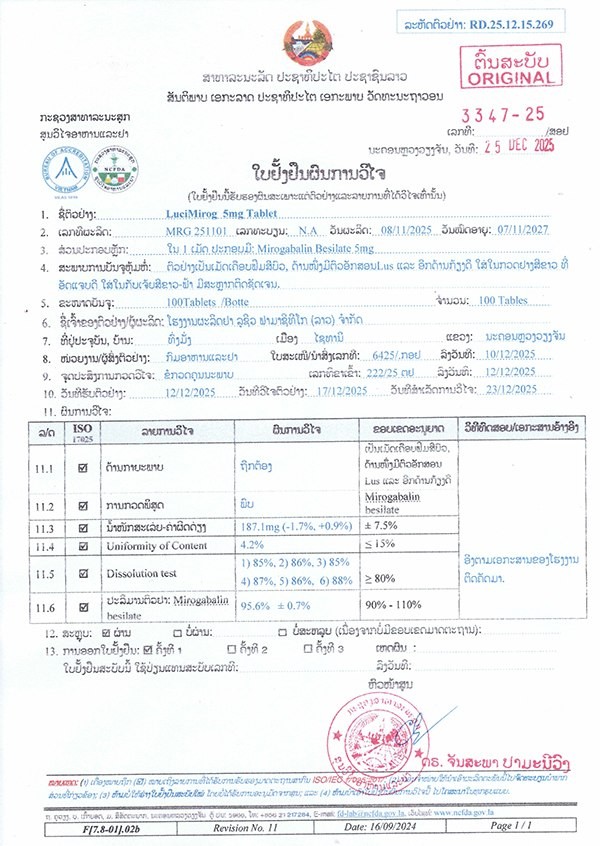
Inspection No.:3347-25
Dosage form:Tablet
Indate:36 months
Mirogabalin (LuciMirog) is a ligand-type calcium channel blocker targeting the α2δ subunit of voltage-dependent calcium channels, used for the symptomatic treatment of neuropathic pain.
Creatinine clearance (CrCl) should be measured before administration, and the starting dose and dosing interval should be determined based on it. Mirogabalin (LuciMirog) is primarily excreted renally; plasma concentrations are elevated and adverse reactions are more likely to occur in patients with renal impairment. Therefore, renal function must be assessed before administration, and dosing should be stratified by creatinine clearance.
The following monitoring should be performed during treatment.
Measure body weight periodically, as Mirogabalin (LuciMirog) can cause weight gain, especially during dose increases or long-term administration.
Observe for central nervous system symptoms such as dizziness, somnolence, and loss of consciousness, which can lead to falls and fractures.
During examinations, inquire about ocular abnormalities such as amblyopia, visual abnormalities, blurred vision, and diplopia.
Monitor for early symptoms of hepatic dysfunction such as general malaise and anorexia, as well as indicators related to renal dysfunction.
Monitor for suicide-related adverse events.
Mirogabalin (LuciMirog) is administered orally, one dose at a time, twice daily.
Usually, for adults, the initial dose of Mirogabalin is 5 mg orally twice daily.
Thereafter, the single dose is increased by 5 mg at intervals of 1 week or more, up to 15 mg orally twice daily.
In addition, the dose may be appropriately increased or decreased within the range of 10 mg to 15 mg per dose twice daily according to age and symptoms.
Missed dose handling for Mirogabalin (LuciMirog) has not been established.
Contraindicated in patients with a history of hypersensitivity to any component of this product.
Mirogabalin (LuciMirog) can cause dizziness, somnolence, and loss of consciousness through central nervous system depression. During administration, patients should not engage in hazardous mechanical operations such as driving a car; if abnormalities occur, appropriate measures such as discontinuation or dose reduction should be taken.
Mirogabalin (LuciMirog) can cause weight gain, the background of which is related to a tendency toward weight gain during Mirogabalin (LuciMirog) treatment, and which is more likely to occur especially during dose increases or long-term administration. While paying attention to obesity, appropriate measures such as dietary therapy and exercise therapy should be taken once signs of obesity appear, and body weight should be measured periodically.
Ocular disorders such as amblyopia, visual abnormalities, blurred vision, and diplopia have been reported with Mirogabalin (LuciMirog) and may occur during administration. Attention should be paid through history-taking regarding ocular disorders during examinations, and appropriate measures should be taken if abnormalities occur.
Abrupt discontinuation of Mirogabalin (LuciMirog) can cause withdrawal symptoms such as insomnia, nausea, diarrhea, and anorexia. When discontinuation is necessary, it should be done cautiously, such as by gradual dose reduction.
Mirogabalin (LuciMirog) is not a causal therapy but a symptomatic therapy for neuropathic pain. The underlying causative disease of the pain should be diagnosed and treated concurrently, and Mirogabalin (LuciMirog) should not be used long-term without a clear purpose.
Suicide-related adverse events have been reported in an international joint placebo-controlled trial conducted in Asia including Japan. Monitor for suicidal ideation and behavior during administration, and take appropriate measures if abnormalities occur.
Fatal cases have been reported in an international joint placebo-controlled trial conducted in Asia including Japan. Closely observe the patient's condition during administration, and take appropriate measures if abnormalities occur.
In an overseas clinical trial in patients with fibromyalgia, overdose cases of 60 mg/day or less have been reported. Symptoms observed with overdose include euphoric mood, dysarthria, headache, dysphagia, arthritis, joint swelling, and asthenia. Mirogabalin (LuciMirog) can be removed by hemodialysis by 15.3%, which may serve as a reference for management.
Administer to pregnant women or women who may be pregnant only when the therapeutic benefit is judged to outweigh the risk.
Consider the therapeutic benefit and the benefits of breastfeeding, and decide whether to continue or discontinue breastfeeding.
The safety and efficacy in pediatric patients have not been established. Clinical trials have not been conducted in children.
Geriatric patients often have reduced renal function; administer cautiously. Mirogabalin (LuciMirog) can cause dizziness, somnolence, loss of consciousness, etc., which may lead to falls and fractures in geriatric patients.
When a single oral dose of Mirogabalin 15 mg was administered to 16 patients with mild and moderate hepatic impairment, Cmax was 1.0 times and 0.8 times, and AUCinf was 0.9 times and 1.1 times, respectively, compared with healthy adults.
When administering to patients with renal impairment, the dose and dosing interval must be adjusted according to the creatinine clearance value. Start at a low dose, confirm tolerability, and then increase if efficacy is insufficient.
First, patients with mild renal impairment (90 > CLcr ≥ 60): the daily dose is 10 mg to 30 mg; the initial dose is 5 mg twice daily; the lowest effective dose is 10 mg twice daily, and the recommended dose is 15 mg twice daily.
Second, patients with moderate renal impairment (60 > CLcr ≥ 30): the daily dose is 5 mg to 15 mg; the initial dose is 2.5 mg twice daily; the lowest effective dose is 5 mg twice daily, and the recommended dose is 7.5 mg twice daily.
Third, patients with severe renal impairment (30 > CLcr, including hemodialysis patients): the daily dose is 2.5 mg to 7.5 mg; the initial dose is 2.5 mg once daily; the lowest effective dose is 5 mg once daily, and the recommended dose is 7.5 mg once daily.
The following adverse reactions may occur; therefore, observe patients sufficiently and take appropriate measures such as discontinuation if abnormalities occur.
First, dizziness (incidence unknown), somnolence (incidence unknown), loss of consciousness (<0.1%). these="" can="" lead="" to="" falls="" and="" fractures="" are="" serious="" central="" nervous="" system="" adverse="" reactions="" specific="" mirogabalin="">
Second, hepatic dysfunction (incidence unknown). Hepatic dysfunction such as AST and ALT elevations may occur. If abnormalities including early symptoms such as general malaise and anorexia occur, discontinue and take appropriate measures.
Third, renal dysfunction (incidence unknown). If renal-related abnormalities occur, take appropriate measures such as discontinuation or dose reduction.
Psychiatric and nervous system: incidence ≥5%: somnolence, floating dizziness; 1% to 5%: orthostatic dizziness, insomnia, loss of consciousness, headache, tremor, hypesthesia; incidence unknown: memory impairment, forgetfulness, dysarthria, hallucinations, delirium, dysgeusia, ageusia, head discomfort, movement disorder, myoclonus.
Ocular: 1% to 5%: blurred vision; incidence unknown: diplopia, visual impairment, decreased visual acuity.
Blood: 1% to 5%: increased eosinophil count.
Cardiovascular: 1% to 5%: orthostatic hypotension, hypertension; incidence unknown: palpitations, hot flashes, decreased blood pressure.
Gastrointestinal: 1% to 5%: constipation, abdominal distension, dry mouth, gastritis, vomiting, increased appetite, decreased appetite, upper abdominal pain, gastroesophageal reflux disease; incidence unknown: diarrhea, abdominal discomfort.
Hepatic: 1% to 5%: liver enzyme elevation.
Urinary: incidence unknown: urinary incontinence, frequent urination, dysuria, urinary retention.
Skin: 1% to 5%: rash; incidence unknown: urticaria, erythema, pruritus.
Other: incidence ≥5%: edema; 1% to 5%: weight gain, gait disturbance, abnormal sensation, rotational dizziness, thirst, facial edema, falls, diabetes (increased glycated hemoglobin, increased blood glucose), malaise, increased blood creatine kinase (CK), eyelid edema, muscle weakness, withdrawal syndrome; incidence unknown: asthenia, pain.
Mirogabalin is primarily excreted renally via glomerular filtration and tubular secretion. Transporters involved in the secretion of Mirogabalin are organic anion transporter (OAT) 1, OAT3, organic cation transporter (OCT) 2, H+/organic cation antiporter (MATE) 1, and MATE2-K. Mirogabalin (LuciMirog) also undergoes metabolism by UDP-glucuronosyltransferase (UGT).
Probenecid: The effect of Mirogabalin (LuciMirog) may be enhanced; when used concomitantly, monitor for signs of enhanced Mirogabalin (LuciMirog) effect and take appropriate measures if abnormalities occur.
Cimetidine: The effect of Mirogabalin (LuciMirog) may be enhanced; when used concomitantly, monitor for signs of enhanced Mirogabalin (LuciMirog) effect and take appropriate measures if abnormalities occur.
Lorazepam, alcohol (drinking): May enhance impairment of attention and balance. Avoid alcohol and pay attention to impaired attention and balance; take appropriate measures if abnormalities occur.
Tramadol: When Mirogabalin and tramadol are used concomitantly, no apparent effect of concomitant administration on the pharmacokinetics of Mirogabalin or tramadol has been observed.
Target and Selectivity: In the nervous system, Mirogabalin exerts its effect by binding to the α2δ subunit that plays an auxiliary role in voltage-dependent calcium channels. Mirogabalin (LuciMirog) also undergoes UGT metabolism and is primarily excreted renally as unchanged drug; it is itself the active ingredient, not a prodrug.
Binding Mode: Mirogabalin binds to the α2δ subunit.
Downstream Pathway: Through this binding, it inhibits calcium currents, thereby exerting analgesic effects. In addition, the analgesic effect of Mirogabalin (LuciMirog) has been suggested to be related to activation of the noradrenergic pathway in the descending pain inhibitory system.

Lucius Pharmaceuticals (Lao) LTD. (Lucius Pharmaceuticals), with its manufacturing campus in Laos located in the capital city of Vientiane in 2020, officially begins its great journey to make effective and affordable medicines available to people in need around the world...More

Lucius Pharmaceutical Co., Ltd., was established in 2020 in Vientiane, the capital of Laos. It aims to offer safe, effective, and affordable medicines globally. With a factory spanning 25,000 square meters, the company manufactures 200+ generic drugs in diverse therapeutic fields.
Address: No.26 Thongmang village, Xaythany district, Vientiane Capital, Laos
E-mail:laoslucius@gmail.com
Name: Lucius
Telegram name: Vira
No.:0085253923643
Telegram name: Vira
No.:0085253923643