Your Health, We Care
Release date: 2025-11-28 13:41:26 Article From: Lucius Laos Recommended: 275
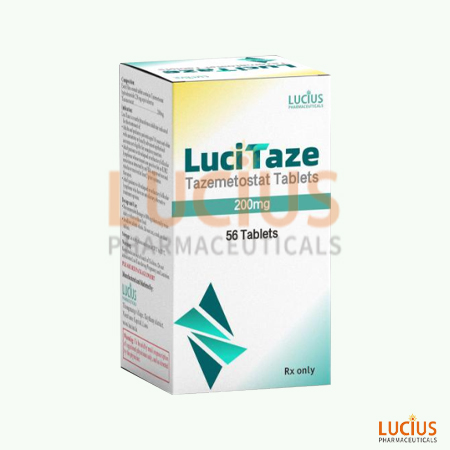
Tazemetostat is a methyltransferase inhibitor indicated for the treatment of:
Adult and pediatric patients aged 16 years and older with metastatic or locally advanced epithelioid sarcoma who are not eligible for complete resection.
Adult patients with relapsed or refractory follicular lymphoma that is positive for EZH2 mutations (detected by an FDA-approved test) and who have received at least 2 lines of systemic therapy.
Adult patients with relapsed or refractory follicular lymphoma for whom no satisfactory alternative treatment options are available.
The recommended dosage is 800 mg orally twice daily, which can be taken with or without food.
Based on findings from animal studies and its mechanism of action, tazemetostat can cause fetal harm when administered to pregnant women. There are no available data on the use of tazemetostat in pregnant women to inform drug-related risks. Administration of tazemetostat to pregnant rats and rabbits during organogenesis resulted in a dose-dependent increase in skeletal developmental abnormalities in both species, starting at a maternal exposure [AUC₀₋₄₅h] approximately 1.5 times the exposure in adults receiving 800 mg twice daily. Inform pregnant women of the potential risk to the fetus.
There are no animal or human data regarding the presence of tazemetostat in human milk, or its effects on breastfed children or milk production. Due to the potential risk of serious adverse reactions in breastfed children, women are advised not to breastfeed during treatment with tazemetostat and for one week after the last dose.
Verify the pregnancy status of females of reproductive potential prior to initiating tazemetostat.
Tazemetostat can cause fetal harm when administered to pregnant women.
Females: Advise females of reproductive potential to use effective non-hormonal contraceptive methods during treatment with tazemetostat and for 6 months after the last dose. Tazemetostat may render certain hormonal contraceptives ineffective [see "Drug Interactions"].
Males: Advise males with female partners of reproductive potential to use effective contraceptive methods during treatment with tazemetostat and for at least 3 months after the last dose.
The safety and effectiveness of TAZVERIK (tazemetostat) have been established in pediatric patients aged 16 years and older (adolescents) with metastatic or locally advanced epithelioid sarcoma. Evidence from adequate and well-controlled studies in adults, including 3 adolescent patients aged 16 years, supports the use of tazemetostat for this indication [see "Adverse Reactions"]. The safety and effectiveness of tazemetostat in pediatric patients younger than 16 years have not been established.
In a 13-week juvenile rat toxicology study, animals were dosed daily from postnatal day 7 to day 97 (roughly equivalent to neonate to adulthood). Tazemetostat caused:
T-LBL effects at doses ≥ 50 mg/kg (approximately 2.8 times the adult exposure at 800 mg twice daily)
Increased trabecular bone at doses ≥ 100 mg/kg (approximately 10 times the adult exposure at 800 mg twice daily)
Increased body weight at doses ≥ 50 mg/kg (approximately equivalent to the adult exposure at 800 mg twice daily)
Testicular dilatation in males at doses ≥ 50 mg/kg (approximately equivalent to the adult exposure at 800 mg twice daily)
Clinical studies of tazemetostat did not include a sufficient number of patients aged 65 years and older with epithelioid sarcoma or relapsed or refractory follicular lymphoma to determine whether their response differs from that of younger subjects.
No dosage adjustment of tazemetostat is recommended for patients with mild to severe renal impairment or end-stage renal disease.
No dosage adjustment is recommended for patients with mild hepatic impairment (total bilirubin > 1 to 1.5 times the upper limit of normal [ULN] or AST > ULN). Tazemetostat has not been studied in patients with moderate (total bilirubin > 1.5 to 3 times ULN) or severe (total bilirubin > 3 times ULN) hepatic impairment.
Secondary Malignancies: Tazemetostat increases the risk of developing secondary malignancies, including T-cell lymphoblastic lymphoma, myelodysplastic syndromes, and acute myeloid leukemia. Monitor patients long-term for the development of secondary malignancies.
Embryo-Fetal Toxicity: May cause fetal harm. Advise patients of the potential risk to the fetus and to use effective non-hormonal contraception.
Concomitant use of tazemetostat with a strong or moderate CYP3A inhibitor increases the plasma concentration of tazemetostat, which may increase the frequency or severity of adverse reactions. Avoid concomitant use of strong or moderate CYP3A inhibitors with tazemetostat. If concomitant use of a moderate CYP3A inhibitor cannot be avoided, reduce the dosage of tazemetostat [see "Dosage and Administration"].
Concomitant use of TAZVERIK (tazemetostat) with a strong or moderate CYP3A inducer may decrease the plasma concentration of tazemetostat, which may reduce the efficacy of tazemetostat. Avoid concomitant use of moderate and strong CYP3A inducers with tazemetostat.
Concomitant use of tazemetostat with CYP3A substrates (including hormonal contraceptives) results in decreased concentrations and reduced efficacy of CYP3A substrates [see "Use in Specific Populations"].
The most common (≥ 20%) adverse reactions in patients with epithelioid sarcoma are pain, fatigue, nausea, decreased appetite, vomiting, and constipation.
The most common (≥ 20%) adverse reactions in patients with follicular lymphoma are fatigue, upper respiratory tract infection, musculoskeletal pain, nausea, and abdominal pain.
Not yet specified.
Tablets.
Store at 20°C to 25°C (68°F to 77°F); short-term transport between 15°C and 30°C (59°F and 86°F) is permitted. Protect from moisture.
On November 21, 2025, the U.S. Food and Drug Administration (FDA) approved the regimen of pembrolizu···【more】
Recommended:[list:visits]2025-17-12
Lung cancer is the most rapidly increasing malignant tumor with the fastest increasing morbidity and···【more】
Recommended:[list:visits]2024-09-07
Lucius Pharmaceuticals Version of Vibegron Now Available1.Basic Drug InformationVibegron (generic na···【more】
Recommended:[list:visits]2026-06-08
In recent years, leveraging the World Trade Organization (WTO) patent waiver for least-developed cou···【more】
Recommended:[list:visits]2026-05-08
How Can Chinese Patients Access Generic Drugs from Laos?In recent years, generic drugs from Laos hav···【more】
Recommended:[list:visits]2026-04-08
Lucius Pharmaceuticals version of Ibrutinib is now availableIn a randomized controlled trial of 269 ···【more】
Recommended:[list:visits]2026-03-08
Leveraging the WTO patent waiver for least-developed countries (extended to 2033), Laos has seen rap···【more】
Recommended:[list:visits]2026-31-07
Alectinib Has Been Launched in LaosAlectinib is an oral targeted therapeutic drug belonging to the c···【more】
Recommended:[list:visits]2026-30-07

Lucius Pharmaceuticals (Lao) LTD. (Lucius Pharmaceuticals), with its manufacturing campus in Laos located in the capital city of Vientiane in 2020, officially begins its great journey to make effective and affordable medicines available to people in need around the world...More

Lucius Pharmaceutical Co., Ltd., was established in 2020 in Vientiane, the capital of Laos. It aims to offer safe, effective, and affordable medicines globally. With a factory spanning 25,000 square meters, the company manufactures 200+ generic drugs in diverse therapeutic fields.
Address: No.26 Thongmang village, Xaythany district, Vientiane Capital, Laos
E-mail:laoslucius@gmail.com

Name: Lucius

Telegram name: Vira
No.:0085253923643
Telegram name: Vira
No.:0085253923643