Your Health, We Care
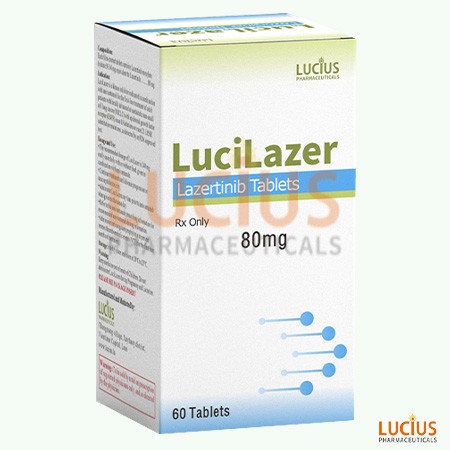
The efficacy of lazertinib in combination with amivantamab was evaluated in MARIPOSA [NCT04487080], a randomized, active-controlled, multicenter trial. Eligible patients were required to have untreated locally advanced or metastatic NSCLC with EGFR mutations (exon 19 deletion or exon 21 L858R substitution) confirmed by local testing, and be ineligible for curative treatment. Patients with asymptomatic or previously treated and stable intracranial metastases were eligible for enrollment.
Patients were randomized in a 2:2:1 ratio to receive lazertinib plus amivantamab (N=429), osimertinib monotherapy (N=429), or lazertinib monotherapy (a regimen not approved for NSCLC) until disease progression or unacceptable toxicity occurred. Efficacy assessment for the treatment of untreated metastatic NSCLC relied on the comparison between the following two groups:
Lazertinib 240 mg orally once daily in combination with amivantamab administered intravenously at a dose of 1050 mg (for patients weighing <80 kg) or 1400 mg (for patients weighing ≥80 kg), once weekly for the first 4 weeks and then once every 2 weeks starting from week 5.
Osimertinib 80 mg orally once daily.
Randomization was stratified by EGFR mutation type (exon 19 deletion or exon 21 L858R substitution), Asian race (yes or no), and history of brain metastases (yes or no). Tumor assessments were performed every 8 weeks for 30 months, and then every 12 weeks until disease progression.
The primary efficacy endpoint was progression-free survival (PFS) as assessed by blinded independent central review (BICR). Other efficacy endpoints included overall survival (OS), overall response rate (ORR), and duration of response (DOR).
A total of 858 patients were randomized across the two study groups, with 429 assigned to the lazertinib plus amivantamab group and 429 to the osimertinib group. The median age was 63 years (range: 25-88); 61% were female; 58% were Asian, 38% were White, 1.6% were American Indian or Alaska Native, 0.8% were Black or African American, 0.2% were Native Hawaiian or Other Pacific Islander, and 0.6% were of unknown or multiple races; 12% were Hispanic or Latino. Eastern Cooperative Oncology Group (ECOG) performance status was 0 (34%) or 1 (66%); 69% were never smokers; 41% had a prior history of brain metastases; 89% had stage IV cancer at initial diagnosis. Tumors in 60% of patients harbored exon 19 deletions, and the remaining 40% had exon 21 L858R substitution mutations.
Among the 858 patients with EGFR exon 19 deletions or L858R substitutions randomized between the amivantamab plus lazertinib group and the osimertinib group, available tissue samples from 544 patients (63%) had evaluable results when retrospectively tested using the cobas EGFR Mutation Test v2. Of these 544 patients with evaluable results, 527 (97%) were positive for EGFR exon 19 deletions or L858R substitutions, while 17 (3%) were negative. Available plasma samples from patients were retrospectively tested to confirm biomarker status using an FDA-approved assay.
The trial demonstrated that lazertinib in combination with amivantamab provided a statistically significant and clinically meaningful improvement in BICR-assessed PFS compared with osimertinib.
FDA,2024.08

Lucius Pharmaceuticals (Lao) LTD. (Lucius Pharmaceuticals), with its manufacturing campus in Laos located in the capital city of Vientiane in 2020, officially begins its great journey to make effective and affordable medicines available to people in need around the world...More

Lucius Pharmaceutical Co., Ltd., was established in 2020 in Vientiane, the capital of Laos. It aims to offer safe, effective, and affordable medicines globally. With a factory spanning 25,000 square meters, the company manufactures 200+ generic drugs in diverse therapeutic fields.
Address:No.26 Thongmang village, Xaythany district, Vientiane Capital, Laos
E-mail:laoslucius@gmail.com
Whatsapp: