Your Health, We Care
Release date: 2025-12-01 17:13:24 Article From: Lucius Laos Recommended: 234
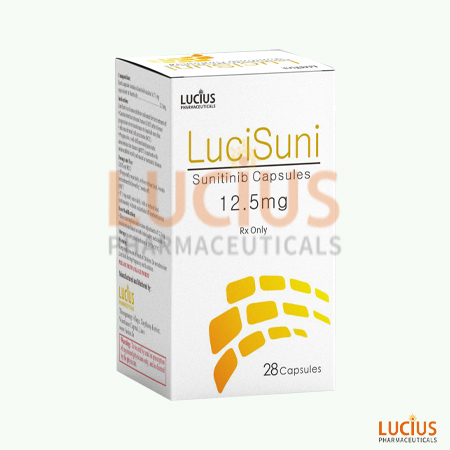
Sunitinib is a kinase inhibitor indicated for the treatment of:
Gastrointestinal stromal tumor (GIST) in patients with disease progression or intolerance to imatinib mesylate.
Advanced renal cell carcinoma (RCC).
Progressive, well-differentiated pancreatic neuroendocrine tumor (pNET) in patients with unresectable locally advanced or metastatic disease.
Administer orally once daily, 50 mg per dose, either on an empty stomach or with food. Treat for 4 weeks followed by a 2-week rest period.
Administer orally once daily, 37.5 mg per dose, either on an empty stomach or with food. Continue treatment continuously without a scheduled treatment interruption period.
Based on individual safety and tolerability, dose interruption and/or dose adjustment to 12.5 mg is recommended.
Sunitinib treatment in pregnant women may cause fetal harm. Since angiogenesis is critical for embryonic and fetal development, sunitinib inhibits angiogenesis and may exert adverse effects on pregnancy. In animal reproductive studies in rats and rabbits, sunitinib exhibited teratogenicity, embryotoxicity, and fetotoxicity. Adequate and well-controlled studies of this drug have not been conducted in pregnant women. If a patient uses this drug during pregnancy or becomes pregnant while receiving treatment with this drug, the patient should be informed of the potential risk of the drug to the fetus. Women of childbearing age should use contraception during treatment with this drug.
The effects of sunitinib on embryos were evaluated in pregnant rats (doses of 0.3, 1.5, 3.0, 5.0 mg/kg/day) and pregnant rabbits (doses of 0.5, 1, 5, 20 mg/kg/day). At a dose of 5 mg/kg/day (approximately 5.5 times the area under the concentration-time curve [AUC] of the human recommended daily dose [RDD]), a significant increase in the incidence of embryonic death and developmental abnormalities was observed in rats. In rabbit studies, a significant increase in embryonic death was observed at a dose of 5 mg/kg/day, and developmental abnormalities were observed at doses ≥1 mg/kg/day (approximately 0.3 times the AUC of the human recommended daily dose of 50 mg/day). Developmental effects included an increased incidence of skeletal malformations (ribs and vertebrae) in rat fetuses. In rabbits, cleft lip was observed at a dose of 1 mg/kg/day, and cleft lip and cleft palate were observed at a dose of 5 mg/kg/day (approximately 2.7 times the AUC of the human recommended daily dose). In rats, no fetal abortion or malformation was observed at doses ≤3 mg/kg/day (approximately 2.3 times the human recommended daily dose).
Sunitinib (doses of 0.3, 1.0, 3.0 mg/kg/day) was evaluated in a pre- and post-natal developmental study in pregnant rats. At doses ≥1 mg/kg/day, maternal body weight gain decreased during pregnancy and lactation; however, no maternal reproductive toxicity was observed at doses <3 mg/kg/day (approximately 2.3 times the AUC of the recommended daily dose in patients). At the high dose of 3 mg/kg/day, both female and male offspring showed decreased body weight from birth until weaning, and male offspring continued to show decreased body weight after weaning. No other developmental toxicity was observed at doses up to 3 mg/kg/day (approximately 2.3 times the AUC of the recommended daily dose in patients).
Sunitinib and/or its metabolites are excreted in rat milk. When lactating female rats were administered 15 mg/kg of sunitinib, sunitinib and its metabolites were extensively excreted in milk, with concentrations in milk up to 12 times those in plasma. It is unknown whether sunitinib and its major active metabolites are excreted in human milk. Since drugs are usually excreted in human milk and may cause potentially serious adverse reactions in nursing infants, lactating women receiving drug treatment should weigh the decision to discontinue breastfeeding or discontinue treatment, taking into account the importance of the drug to the mother.
The safety and efficacy of this drug in pediatric patients have not been established.
Of the 825 patients with gastrointestinal stromal tumor (GIST) and advanced renal cell carcinoma (RCC) who received this drug, 277 (34%) were 65 years of age or older. In the phase 3 study of pancreatic neuroendocrine tumors, 22 (27%) subjects who received sunitinib were 65 years of age or older. No differences in safety or efficacy were observed between younger and older subjects.
Hepatotoxicity, including hepatic failure, has been observed. Monitor liver function tests before the start of treatment, during each treatment cycle, and when clinically indicated. For grade 3 or 4 drug-related hepatic adverse events, interrupt sunitinib treatment; discontinue use if no resolution occurs. Do not restart sunitinib if the patient subsequently develops severe changes in liver function tests or other signs and symptoms of hepatic failure.
Women of childbearing age should be informed of the potential risk to the fetus and advised to avoid pregnancy.
Cardiotoxicity has occurred, including left ventricular ejection fraction (LVEF) decreasing below the lower limit of normal and heart failure (including death). Monitor patients for signs and symptoms of congestive heart failure.
QT interval prolongation and torsades de pointes have been observed. Patients at higher risk of QT interval prolongation should use sunitinib with caution. When using sunitinib, consider monitoring electrocardiograms (ECGs) and electrolytes during treatment.
Hypertension may occur. Monitor blood pressure and treat as needed.
Bleeding events have occurred, including tumor-related bleeding. Perform serial complete blood counts (CBCs) and physical examinations.
Thyroid dysfunction may occur. Patients with signs and/or symptoms of hypothyroidism or hyperthyroidism should undergo laboratory monitoring of thyroid function and be treated according to standard medical practice.
Patients undergoing major surgical procedures are advised to temporarily interrupt sunitinib treatment.
Adrenal hemorrhage has been observed in animal studies. Monitor adrenal function in stressful situations such as surgery, trauma, or severe infection.
Strong CYP3A4 inhibitors (e.g., ketoconazole) may increase the plasma concentration of sunitinib. Concomitant use of drugs with no or minimal inhibitory effects on this enzyme is recommended. If concomitant use with a strong CYP3A4 inhibitor is necessary, consider reducing the dose of sunitinib. In healthy volunteers who received a single dose of sunitinib malate with a strong CYP3A4 inhibitor (ketoconazole), the overall (sunitinib and its major active metabolite) Cmax (maximum concentration) and AUC₀-∞ (area under the concentration-time curve from time zero to infinity) increased by 49% and 51%, respectively. Concomitant use of sunitinib with strong inhibitors of the CYP3A4 enzyme system (e.g., ketoconazole, itraconazole, clarithromycin, atazanavir, indinavir, nefazodone, nelfinavir, ritonavir, saquinavir, telithromycin, voriconazole) may increase sunitinib concentrations; grapefruit may also increase sunitinib plasma concentrations. If concomitant use with a strong CYP3A4 inhibitor is necessary, consider reducing the dose of sunitinib (see [Dosage and Administration]).
CYP3A4 inducers (e.g., rifampicin) may decrease the plasma concentration of sunitinib. Concomitant use of drugs with no or minimal inductive effects on this enzyme is recommended. In healthy volunteers who received a single dose of sunitinib with a strong CYP3A4 inducer (rifampicin), the overall (sunitinib and its major active metabolite) Cmax and AUC₀-∞ decreased by 23% and 46%, respectively. Concomitant use of sunitinib with inducers of the CYP3A4 enzyme system (e.g., dexamethasone, phenytoin, carbamazepine, rifampicin, rifabutin, rifapentine, phenobarbital, St. John’s wort) may decrease sunitinib concentrations. St. John’s wort may cause a sudden decrease in sunitinib plasma concentrations; patients receiving sunitinib treatment should not take St. John’s wort concomitantly. If concomitant use with a CYP3A4 inducer is necessary, consider increasing the dose of sunitinib (see [Dosage and Administration]).
In vitro study results indicate that sunitinib does not induce or inhibit major CYP enzymes.
Management of sunitinib overdosage includes general supportive measures. There is no specific antidote for the treatment of sunitinib overdosage. If clinically indicated, emesis or gastric lavage may be used to remove unabsorbed drug. A small number of accidental overdosage events have been reported; these cases either were consistent with the known adverse reactions of sunitinib or had no adverse reactions. One case of intentional overdosage (attempted suicide by ingesting 1500 mg of sunitinib) was reported with no adverse reactions.
In non-clinical studies, death was observed in rats at a dose of 500 mg/kg (3000 mg/m²)/day administered for at least 5 days. At this dose level, signs of toxicity included impaired muscle coordination, head shaking, decreased activity, ocular discharge, piloerection, and gastrointestinal distress. Death and similar signs of toxicity were also observed at lower dose levels with longer treatment durations.
The most common adverse reactions (≥20%) are fatigue, asthenia, fever, diarrhea, nausea, mucositis/stomatitis, vomiting, dyspepsia, abdominal pain, constipation, hypertension, peripheral edema, rash, hand-foot syndrome, skin discoloration, dry skin, hair color changes, taste alteration, headache, back pain, arthralgia, extremity pain, cough, dyspnea, anorexia, and bleeding.
Not established.
Capsules.
Store at 20℃ to 25℃ (68℉ to 77℉); short-term transportation between 15℃ and 30℃ (59℉ and 86℉) is permitted. Protect from moisture.
On November 21, 2025, the U.S. Food and Drug Administration (FDA) approved the regimen of pembrolizu···【more】
Recommended:[list:visits]2025-17-12
Lung cancer is the most rapidly increasing malignant tumor with the fastest increasing morbidity and···【more】
Recommended:[list:visits]2024-09-07
Lucius Pharmaceuticals Version of Vibegron Now Available1.Basic Drug InformationVibegron (generic na···【more】
Recommended:[list:visits]2026-06-08
In recent years, leveraging the World Trade Organization (WTO) patent waiver for least-developed cou···【more】
Recommended:[list:visits]2026-05-08
How Can Chinese Patients Access Generic Drugs from Laos?In recent years, generic drugs from Laos hav···【more】
Recommended:[list:visits]2026-04-08
Lucius Pharmaceuticals version of Ibrutinib is now availableIn a randomized controlled trial of 269 ···【more】
Recommended:[list:visits]2026-03-08
Leveraging the WTO patent waiver for least-developed countries (extended to 2033), Laos has seen rap···【more】
Recommended:[list:visits]2026-31-07
Alectinib Has Been Launched in LaosAlectinib is an oral targeted therapeutic drug belonging to the c···【more】
Recommended:[list:visits]2026-30-07

Lucius Pharmaceuticals (Lao) LTD. (Lucius Pharmaceuticals), with its manufacturing campus in Laos located in the capital city of Vientiane in 2020, officially begins its great journey to make effective and affordable medicines available to people in need around the world...More

Lucius Pharmaceutical Co., Ltd., was established in 2020 in Vientiane, the capital of Laos. It aims to offer safe, effective, and affordable medicines globally. With a factory spanning 25,000 square meters, the company manufactures 200+ generic drugs in diverse therapeutic fields.
Address: No.26 Thongmang village, Xaythany district, Vientiane Capital, Laos
E-mail:laoslucius@gmail.com

Name: Lucius

Telegram name: Vira
No.:0085253923643
Telegram name: Vira
No.:0085253923643